

Call 1 (425) 406-1174 to start a Data Recovery!
RAID Array Data Recovery
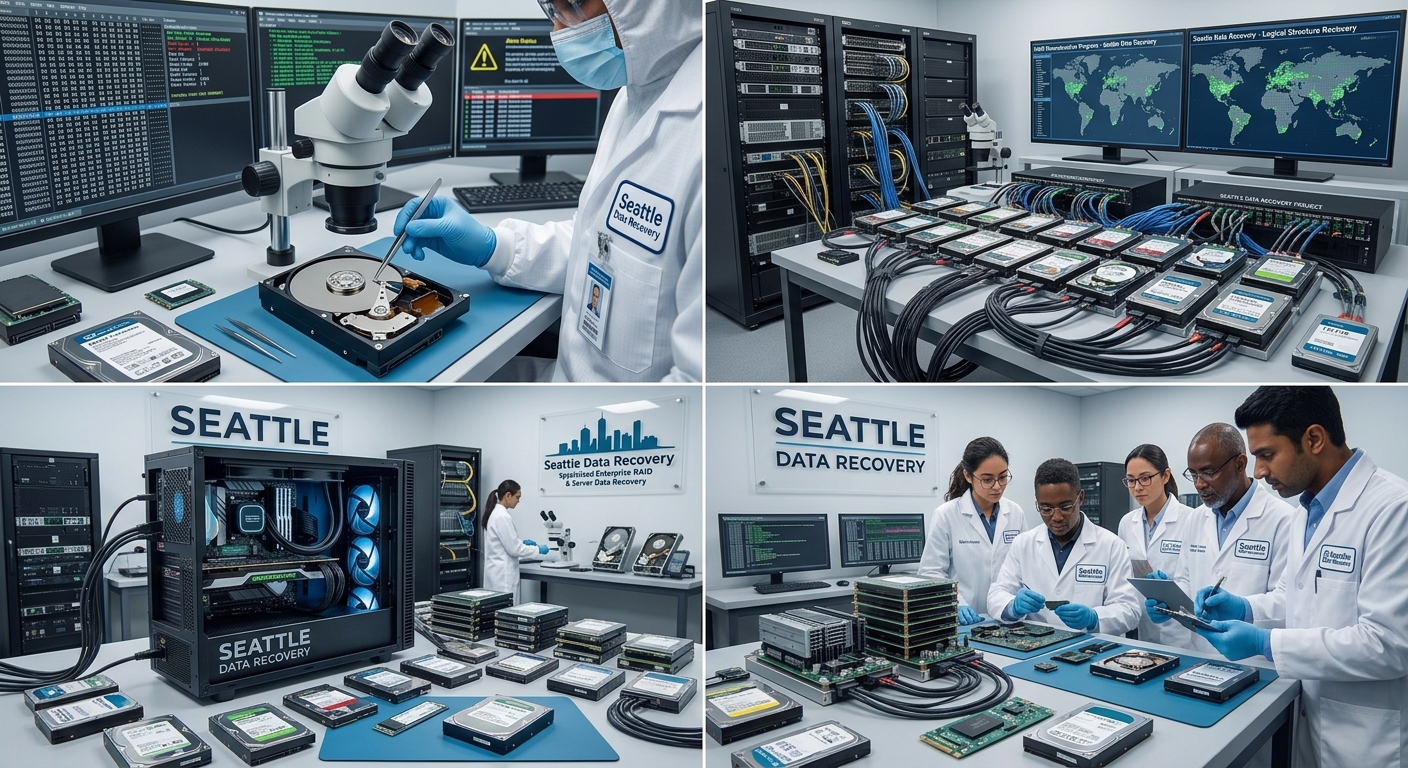
High-Stakes RAID Recovery Scenarios in the Seattle Tech Corridor
- Multi-Drive Failures in Redundant Arrays (RAID 5 / RAID 6): While RAID 5 can tolerate a single disk failure, massive electrical surges—such as those caused by winter windstorm power grid drops in Seattle—frequently force two or more drives offline simultaneously, causing the entire logical volume to collapse.
- NAS Controller and Enclosure Failures: In many business environments, the physical disks remain entirely healthy, but the underlying hardware controller or internal Linux-based file system metadata (
mdadmconfigurations, ext4, or Btrfs) becomes severely corrupted, rendering the network shares completely unreadable. - RAID 0 Striping Failures: Because RAID 0 focuses entirely on speed by striping data across multiple drives without any built-in parity or redundancy, the failure of just one single drive instantly destroys the entire file structure.
Institutional Case Study: RAID 0 Emergency Recovery for the Catholic Church in Washington State
The Technical Challenges & Risks
The Laboratory Intervention Workflow
- Hardware-Level Diagnostic Isolation: The failed physical drive was isolated inside our ISO 5 cleanroom. Engineers bypassed the broken hardware controller entirely, using advanced hardware emulators to stabilize the drive's microcode and read the unstable sectors safely.
- Bit-Stream Raw Cloning: Write-blocked, sector-by-sector clones were generated for every single drive in the array. This process ensured that the original parish school drives remained completely unaltered, preserving a strict evidentiary forensic standard.
- Virtual Block Realignment & Re-Stitching: Utilizing proprietary software emulation tools, our specialists calculated the original controller's block size, drive ordering, and offset parameters. This allowed us to virtually reconstruct the striped data architecture without needing the original broken server hardware.
- 100% File System Extraction: By successfully rebuilding the virtual parameters, the laboratory bypassed the corruption and extracted 100% of the uncorrupted files, safely exporting the school’s entire historical and operational infrastructure onto modern, secure solid-state storage.
Secure B2B Intake at Our Ballard Laboratory
- Details
- Written by: Seattle Data Recovery
- Category: Enterprise Storage Data
- The Specific Models We Recover:
- Why They Are Used: These drives boast a 550TB per year workload rating and an unmatched 2.5 Million Hour MTBF (Mean Time Between Failures). They feature dedicated Rotational Vibration (RV) sensors that detect ambient chassis vibration and dynamically adjust the drive head positioning, keeping data throughput perfectly stable even when multiple disks are spinning simultaneously. [1]
- The Specific Models We Recover: The WD Gold Enterprise SATA 6G Series (covering capacities ranging from 1TB all the way up to 24TB per disk). [1]
- Why They Are Used: WD Gold drives feature specialized firmware designed explicitly for hardware RAID controllers, utilizing TLER (Time-Limited Error Recovery) microcode. This prevents the drive from dropping out of the array prematurely during an intensive read error, keeping business volumes online. [1]
- SATA Native Interfacing: We bypass the internal Oxford or proprietary SanDisk Thunderbolt 3 bridge controllers entirely. We extract the raw Ultrastar DC or WD Gold SATA disks and lock them onto our specialized firmware emulation benches to read data directly from the platters. [1, 2, 3]
- Helium Armor Extraction: For failed higher-capacity drives (like the Ultrastar HC550 or HC570), the drive chassis is structurally sealed with Helium gas. If a mechanical head swap is required, our technicians perform precision micro-surgery within our specialized ISO Class 5 Cleanroom to balance the platters before the internal atmosphere compromises the structural alignment. [1]
- RAID Stripe Reconstruction: Once block-level clones of the internal Ultrastar or Gold drives are secured, we reverse-engineer the hardware striping blocks (RAID 0, 5, or 10 matrices) to stitch the original filesystem—whether Apple APFS, HFS+, or Windows NTFS—perfectly back together. [1, 2]
- Details
- Written by: Seattle Data Recovery
- Category: Enterprise Storage Data
- The Standout Hardware: The Western Digital Ultrastar DC SS530 SAS SSD.
- Why Servers Run Them: These high-density 2.5" solid-state drives utilize a Dual-Port 12Gb/s SAS interface. Dual-port design allows for two separate physical data pathways to the same drive cells. If a server host controller or a path line completely fails, the storage array instantly switches to the secondary port with zero downtime. Delivering an unbeaten 2.5 Million Hour MTBF, these drives are specifically engineered to drive mission-critical enterprise applications like local ERP platforms and large SQL databases. [1, 2]
- The Standout Hardware: The Ultrastar DC HC550, HC580, and HC680 (ranging from 14TB all the way up to 28TB per drive slot). [1, 2]
- Why Servers Run Them: These high-capacity hard drives leverage Western Digital’s signature HelioSeal technology, swapping out standard air inside the drive chamber for dense Helium gas. Because Helium creates a fraction of the internal friction and aerodynamic turbulence of air, the internal mechanical platters spin significantly cooler, draw less power, and can be packed much closer together. [1, 2]
- Additionally, modern versions like the Ultrastar DC HC580 integrate ArmorCache technology. This feature uses OptiNAND flash storage to protect your unwritten cache data if the host server suddenly drops physical power. [1]
- The Standout Hardware: The Western Digital Gold Enterprise SATA HDD Series (available in capacities spanning up to 24TB+).
- Why Servers Run Them: WD Gold drives feature specialized internal microcode tailored specifically to interface smoothly with hardware RAID controllers. They utilize TLER (Time-Limited Error Recovery) firmware. In standard consumer drives, if a bad sector is encountered, the drive will freeze for up to several minutes trying to read the block, causing the RAID controller to assume the drive is completely dead and violently kick it out of the array. A WD Gold drive limits its error correction window to just a few seconds, reporting the error to the controller so the array can smoothly handle the data parity calculation without falling offline. [1, 2, 3]
+-------------------------+-----------------------------------------+-----------------------------------------+

| Feature                 | Western Digital Gold Enterprise         | Ultrastar DC SS530 Enterprise SSD       |
+-------------------------+-----------------------------------------+-----------------------------------------+

| Interface Connector     | Enterprise SATA 6Gb/s                   | Dual-Port 12Gb/s SAS                    |
| Storage Medium          | Helium-Sealed Mechanical Platters       | High-End 3D TLC NAND Flash Cells        |
| Redundancy Architecture | TLER Firmware (RAID Controller Guard)   | Dual-Port Failover Pathway Protection    |
| Primary Workload Target | Massive local backups & data archives   | High-Velocity Databases & ERP Servers   |
+-------------------------+-----------------------------------------+-----------------------------------------+
- Dual-Port SAS Emulation: When handling dual-port drives like the Ultrastar DC SS530, our recovery benches use custom hardware links to read raw sectors from both data paths simultaneously, allowing us to safely bypass damaged internal ports. [1]
- OptiNAND Flash Decoding: For modern drives using integrated flash layers (like the Ultrastar HC580), we don't just read the mechanical platters. Our specialists utilize specialized software to safely flush out the non-volatile cache data hidden inside the drive's built-in NAND memory, ensuring every transaction file is perfectly restored. [1]
- Details
- Written by: Seattle Data Recovery
- Category: Enterprise Storage Data
- Native IT-Mode Interfacing: Our engineers extracted all twelve enterprise drives from the TrueNAS cluster trays. We bypassed the original server infrastructure entirely, connecting each disk to our raw hardware data recovery imagers running custom SAS/SATA firmware in non-RAID IT-mode.
- Pristine Block-Level Imaging: One of the older drives had developed mechanical head latency from the power surge. We modified its internal microcode to prevent it from dropping offline, successfully extracting 100% bit-level forensic clones of all twelve hard drives into pristine image files.
- OpenZFS Structure Analysis and Extraction: TrueNAS does not use traditional hardware RAID. Instead, it virtualizes storage via Software VDEVs. Our data recovery specialists loaded the twelve raw drive clones into a specialized, isolated Linux environment. Using custom OpenZFS engineering software, we bypassed the corrupted ZIL (ZFS Intent Log) and manually reconstructed the broken vdev label metadata blocks. By stepping back through historical TXGs (Transaction Groups) to a point right before the corruption occurred, we successfully forced the virtual pool to mount in read-only mode, extracting 100% of the client's critical VM datastores.
- The Target Build: High-performance ASUS PCIe NVMe expansion cards loaded directly into the TrueNAS server's open PCIe slots.
- The High-Density Build: By leveraging motherboard PCIe slot bifurcation, we fit 4 ultra-fast M.2 NVMe SSDs per single PCIe slot. By configuring these in a software-defined RAID matrix, we strip away standard bottleneck limitations, allowing your cluster node to process heavy database workloads and virtual machines simultaneously at blistering performance up to 7,000+ MB/s.
- The Target Build: Converting your server front-end into a dedicated 2.5-Inch SFF Enterprise SSD Array.
- The Hardware Architecture: Powered by server-grade enterprise U.2/U.3 NVMe or SAS 2.5" SFF solid-state drives, loaded with built-in hardware Power Loss Protection (PLP) via internal capacitor arrays.
+-------------------------+-----------------------------------------+-----------------------------------------+-----------------------------------------+
| Performance Metric      | Legacy TrueNAS HDD Cluster Setup        | PCIe NVMe (ASUS Card) Upgrade           | SFF 2.5" Enterprise SSD Array           |
+-------------------------+-----------------------------------------+-----------------------------------------+-----------------------------------------+
| Form Factor Profile     | Bulky 3.5" Mechanical Drive Trays       | Internal PCIe Expansion Slots           | 2.5" SFF Hot-Swappable Front Bays      |
| Storage Medium          | Friction-heavy mechanical spinning disks| Pure solid-state NVMe flash memory cells| Server-grade U.2/U.3 NVMe or SAS Flash |
| Real-World Read/Write   | ~400 MB/s - 650 MB/s sequential max     | Blistering speeds **up to 7,000+ MB/s** | Sustained high IOPS (Up to 4,000 MB/s) |
| Power Outage Security   | High risk of unwritten file corruption  | Built-in hardware Power Loss Protection | Full Hardware-Level PLP Protection     |
| Maintenance Design      | Hot-Swappable (But slow rebuilding)     | Internal Workstation/Motherboard Fixed  | Hot-Swappable (Near-Instant Rebuilding)|
+-------------------------+-----------------------------------------+-----------------------------------------+-----------------------------------------+
- Hardware Power Loss Protection (PLP): Consumer solid-state drives lack internal power safety nets, causing deep write degradation in OpenZFS environments. The enterprise-class PCIe and 2.5" SFF SSD targets we deploy feature built-in hardware PLP capacitors. They provide enough temporary emergency electrical power to safely write all in-transit cache data into secure flash storage cells during a sudden power loss event, completely preventing volume corruption.
- Sustained Enterprise IOPS: While consumer SSDs offer fast burst speeds that quickly drop off during large transfers, enterprise-grade solid-state arrays maintain stable, predictable, high-speed input/output operations under unrelenting, parallel multi-user enterprise workloads.
- OpenZFS Self-Healing Optimization: By pairing the self-healing, copy-on-write architecture of OpenZFS with pure solid-state memory, data scrubbing routines finish in minutes rather than days. The system actively detects and corrects silent data corruption on the fly with zero performance impact.
- Details
- Written by: Seattle Data Recovery
- Category: Enterprise Storage Data
- Cleanroom Physical Restoration: Our engineers extracted all eight drives from the Dell hot-swap caddies. The physically seized Drive 1 was moved straight into our ISO Class 5 Cleanroom. Under microscopic magnification, our technicians carefully unsealed the drive, cleaned microscopic debris off the platters, and executed a high-precision platter swap into a perfectly calibrated OEM chassis with a functioning spindle assembly.
- Firmware Optimization & Sector Reading: Drive 2 (the firmware-damaged disk) was connected to our specialized hardware data recovery imagers. We modified the drive's internal firmware microcode to bypass background error-retry loops, allowing our imagers to safely clone 100% of the raw, bit-level sectors before the disk could degrade further.
- Reverse-Engineering Dell PERC Metadata: Dell PERC controllers write unique, proprietary metadata stamps at the end of every drive to track the RAID geometry (virtual disk sequence, stripe sizes, and sector offsets). Standard operating systems cannot read these drives natively when pulled from a broken server. Our recovery specialists loaded the eight bit-level clones onto our advanced array reconstruction benches, stripped away the proprietary PERC headers, and reverse-engineered the exact configuration math. By stitching the virtual volume back together, we successfully repaired the underlying Windows Server NTFS file structure and achieved a 100% complete recovery of the client's SQL databases.
- The Target Build: High-performance ASUS PCIe NVMe expansion cards loaded directly into the server's open PCIe slots.
- The High-Density Build: By leveraging motherboard PCIe slot bifurcation, we fit 4 ultra-fast M.2 NVMe SSDs per single PCIe slot. By configuring these in a software-defined RAID matrix, we strip away standard bottleneck limitations, allowing your server to process heavy database workloads and virtual machines simultaneously at blistering performance up to 7,000+ MB/s.
- The Target Build: Converting your server front-end into a dedicated 2.5-Inch SFF Enterprise SSD Array.
- The Hardware Architecture: Powered by server-grade enterprise U.2/U.3 NVMe or SAS 2.5" SFF solid-state drives, loaded with built-in hardware Power Loss Protection (PLP) via internal capacitor arrays.
+-------------------------+-----------------------------------------+-----------------------------------------+

| Performance Metric      | Legacy Dell PowerEdge HDD Setup         | PCIe NVMe (ASUS Card) Upgrade           | SFF 2.5" Enterprise SSD Array           |
+-------------------------+-----------------------------------------+-----------------------------------------+

| Form Factor Profile     | Bulky 3.5" Mechanical Drive Trays       | Internal PCIe Expansion Slots           | 2.5" SFF Hot-Swappable Front Bays      |
| Storage Medium          | Friction-heavy mechanical spinning disks| Pure solid-state NVMe flash memory cells| Server-grade U.2/U.3 NVMe or SAS Flash |
| Real-World Read/Write   | ~150 MB/s - 450 MB/s sequential max     | Blistering speeds **up to 7,000+ MB/s** | Sustained high IOPS (Up to 4,000 MB/s) |
| Power Outage Security   | High risk of unwritten file corruption  | Built-in hardware Power Loss Protection | Full Hardware-Level PLP Protection     |
| Maintenance Design      | Hot-Swappable (But slow rebuilding)     | Internal Workstation/Motherboard Fixed  | Hot-Swappable (Near-Instant Rebuilding)|
+-------------------------+-----------------------------------------+-----------------------------------------+
- Hardware Power Loss Protection (PLP): Consumer solid-state drives lack internal power safety nets. If your building suffers a sudden blackout or power surge, active cache data is lost or corrupted. The enterprise-class PCIe and 2.5" SFF SSD targets we deploy feature built-in hardware PLP capacitors. They provide enough temporary emergency electrical power to safely write all in-transit cache data into secure flash storage cells during a sudden power loss event, completely preventing volume corruption.
- Sustained Enterprise IOPS: While consumer SSDs offer fast burst speeds that quickly drop off during large transfers, enterprise-grade solid-state arrays maintain stable, predictable, high-speed input/output operations under unrelenting, parallel multi-user enterprise workloads.
- Elimination of Mechanical Failure Points: By stripping away spindle motors, delicate read heads, and mechanical platters, you eliminate 90% of traditional storage hardware failure risks.
- Details
- Written by: Seattle Data Recovery
- Category: RAID 10 (RAID 1+0 - Striping of mirrors)
- RAID Controller Malfunction or Corruption
- Case Study: Dual-Medium Recovery on a Modern G-RAID PROJECT Enclosure & PRO-BLADE NVMe Ecosystem
- Case Study: Recovering a Collapsed Cisco UCS C-Series Rack Server Array & Upgrading to Next-Gen Enterprise Solid-State Infrastructure
- Unrecoverable Read Errors (URE) and "Silent" Bad Sectors
Subcategories
RAID Performance
Data Recovery and Seamless Migration to New High-Performance RAID Systems
The Recovery-to-High-Performance RAID Pipeline
Phase 1: Forensic Extraction and Structural Alignment
- Any failing drive members from your old system (whether clicking hard drives, dead SSDs, or a degraded multi-disk RAID) are stabilized inside our ISO 5 Cleanroom or micro-soldering stations.
- We utilize hardware imagers like the PC-3000 to create a bit-for-bit digital clone of your data layers.
- If your original file structure was fractured, our engineers manually recalculate block sizes, parity rotations, and stripe patterns to virtually reconstruct your original databases, virtual machines, or media catalogs onto our secure laboratory servers.
Phase 2: Building Your New High-Performance Storage Array
- All-Flash NVMe RAID Arrays: For hyper-speed video editing bays (4K/8K production) or heavy SQL database environments, we build all-flash arrays that deliver massive input/output operations per second (IOPS) and eliminate mechanical bottlenecks entirely.
- Resilient Enterprise RAID Topologies: Depending on whether your organization prioritizes absolute write speeds or total fault tolerance, we configure new enterprise hardware enclosures into optimized RAID 5, RAID 6, or RAID 10 environments.
- Next-Generation File Systems: We structure the new arrays using cutting-edge, self-healing file systems like ZFS, Btrfs, or modern APFS Containers to ensure maximum data integrity and automatic block-level error checking.
Phase 3: High-Speed Direct-Attached Bitstream Migration
- At Seattle Data Recovery, we bridge our forensic imaging servers directly to your new high-performance RAID enclosure using high-bandwidth pipelines, such as 10GbE/40GbE network interfaces or Thunderbolt 4 / PCIe Direct-Attached Storage (DAS) buses.
- This allows us to pipe your recovered data onto the new drives at maximum hardware line speed, fully verifying every block with cryptographic checksums to guarantee that original file names, date timestamps, and complex directory hierarchies remain 100% intact and uncorrupted.
Enterprise-Grade Compliance and Total Physical Security
- Strict HIPAA & SOC 2 Compliance: We maintain an ironclad internal chain of custody to protect financial ledgers, legal assets, and Protected Health Information (PHI) throughout both the extraction and migration workflows.
- Exclusive Physical Security: Our laboratory is located inside a secure professional medical building with strictly monitored perimeters, minimizing outside traffic and protecting high-value business storage assets.
- Secure Hardware Decommissioning: Old, failed drives that are replaced during the recovery process undergo verified physical destruction, ensuring no data residue ever leaves our laboratory.
Operational Checklist for IT Managers Facing Array Collapse
- Sever Power to Noisy Enclosures: If a drive inside your old array begins clicking or beeping, shut the unit down instantly. Forcing an unstable mechanical drive to keep spinning can physically score the platters, making recovery impossible.
- Do Not Attempt an Automatic "Rebuild" on Failing Hardware: Forcing a degraded RAID to try and rebuild itself with a failing disk puts immense strain on the remaining healthy drives. This thermal and mechanical stress frequently triggers a secondary drive failure, collapsing the volume permanently.
- Deploy Clean Target Media: Never attempt to patch data back onto a drive that has previously failed or shown bad sectors. Temporary software fixes will inevitably drop out again, risking secondary data loss.
Enterprise Storage Data
+------------------------+---------------------------------------+---------------------------------------+

| Feature                | Standard Desktop/Laptop HDD           | Enterprise HDD                        |
+------------------------+---------------------------------------+---------------------------------------+

| Workload Rating        | ~55 TB / year (Intermittent use)      | 550+ TB / year (24/7/365 Continuous)  |
| MTBF (Reliability)     | ~1 Million Hours                      | 2.0 to 2.5 Million Hours              |
| Vibration Tolerance    | Low (Prone to failure in multi-drive) | High (RV Sensors stabilize multi-drive)|
| Warranty & Quality     | 2–3 Years (Standard components)       | 5 Years (Premium, heavy-duty parts)   |
+------------------------+---------------------------------------+---------------------------------------+
- Standard HDDs are designed for typical 8-hour workdays. If placed into a multi-drive server or network-attached storage (NAS) environment, the combined rotational vibration of surrounding disks will quickly degrade and destroy standard consumer drives.
- Enterprise HDDs feature Rotational Vibration (RV) sensors and robust mechanical parts. They are engineered to spin constantly in dense, high-vibration rackmount chassis without losing data integrity.
The Scenario: A client brought us a failing 8-Drive HDD RAID 6 array from a corporate file server.Our Solution: After successfully cloning and recovering 100% of the data in our lab, we didn’t just dump the files onto standard external drives. To ensure business continuity, we rebuilt and transferred the data onto a brand-new Enterprise HDD RAID array utilizing premium enterprise disks. For clients looking to future-proof their operations, we frequently use this opportunity to upgrade them to an Enterprise SSD RAID array, cutting data access times from milliseconds to microseconds.
+------------------------+---------------------------------------+---------------------------------------+

| Feature                | Standard Laptop/Desktop SSD           | Enterprise SSD                        |
+------------------------+---------------------------------------+---------------------------------------+

| Power Loss Protection  | None (Data in transit can be lost)    | Hardware PLP (Capacitors save data)   |
| Write Endurance (TBW)  | Low (Designed for casual usage)       | Extremely High (Constant write cycles)|
| Performance Stability  | High burst, throttles under heavy load| Consistent, sustained peak IOPS       |
+------------------------+---------------------------------------+---------------------------------------+
- Standard SSDs excel at quick bursts of speed—like opening a laptop application or booting up a PC. However, during prolonged business workloads, they quickly overheat, exhaust their cache, and experience severe performance drops. Crucially, they lack protection against sudden power outages.
- Enterprise SSDs feature Power Loss Protection (PLP) via onboard capacitors. If the power cuts out, the drive has enough temporary hardware power to safely flush data from its volatile cache into safe storage. They also boast massively superior Terabytes Written (TBW) endurance ratings.
The Scenario: We recently recovered a premium G-RAID PRO 2 dual-drive hardware array—a high-performance enterprise enclosure relied upon by creative professionals and businesses.Our Solution: To match the exact enterprise-grade quality, speed, and hardware-encrypted reliability of the original system, we transferred the recovered data onto a top-tier SanDisk Professional PRO-G40 ultra-rugged dual-mode drive, ensuring the client's workflow didn't miss a beat.
- High Density: We can fit 4 ultra-fast NVMe M.2 SSDs per single PCIe slot.
- Unmatched Speed: By configuring these in a RAID array, we strip away standard bottleneck limitations, allowing your server to process heavy database workloads, virtual machines, and local applications simultaneously.
- We build massive, hot-swappable arrays using Enterprise 2.5" SSDs.
- These arrays provide the sustained IOPS, hardware-level Power Loss Protection, and structural reliability needed to keep data centers running 24/7/365 without degradation.
RAID 0 (Striping)
Splits data evenly across two or more drives without redundancy or parity. It offers high read and write speeds, but a failure of any single drive destroys the entire array. Requires a minimum of 2 drives.
RAID 1 (Mirroring)
Writes identical data to all drives in the set. It provides high reliability and read performance, but usable storage is cut in half (50% capacity). Requires an even number, with a minimum of 2 drives.
RAID 5 (Striping with distributed parity)
Stripes data and rotates parity information across all drives. It tolerates the failure of a single drive while maintaining good read speeds. Requires a minimum of 3 drives.
RAID 6 (Striping with dual distributed parity)
Similar to RAID 5, but calculates two sets of parity data instead of one. It can survive the simultaneous failure of up to two drives. Requires a minimum of 4 drives.
RAID 10 (RAID 1+0 - Striping of mirrors)
Combines mirroring and striping by creating mirrored pairs and striping data across them. It delivers high performance and strong fault tolerance (tolerating one drive failure per mirrored pair), using 50% of total capacity. Requires a minimum of 4 drives.
RAID 50 (RAID 5+0)
Combines data striping (RAID 0) across multiple RAID 5 sub-arrays. It improves performance and can survive the loss of one drive in each RAID 5 sub-array. Requires a minimum of 6 drives.
RAID 60 (RAID 6+0)
Combines data striping (RAID 0) across multiple RAID 6 sub-arrays. It tolerates up to two drive failures in each RAID 6 sub-array. Requires a minimum of 8 drives.








